Project / 04
Osteoporosis Therapy
- Synthetic biology
- Research
- Simulation
A competition proposal to engineer a gut bacterium into a delivery system for bone protein, aimed at osteoporosis.
Snapshot
The fast read
- Role
- Team lead
- Year
- 2025
- Status
- Proposal — no laboratory work
- Type
- Competition
- Team
- Four classmates, with a mentor from UC Berkeley
- Stack
- Python, Plasmid design
- Tags
- Synthetic biology · Research · Simulation
Section
The problem
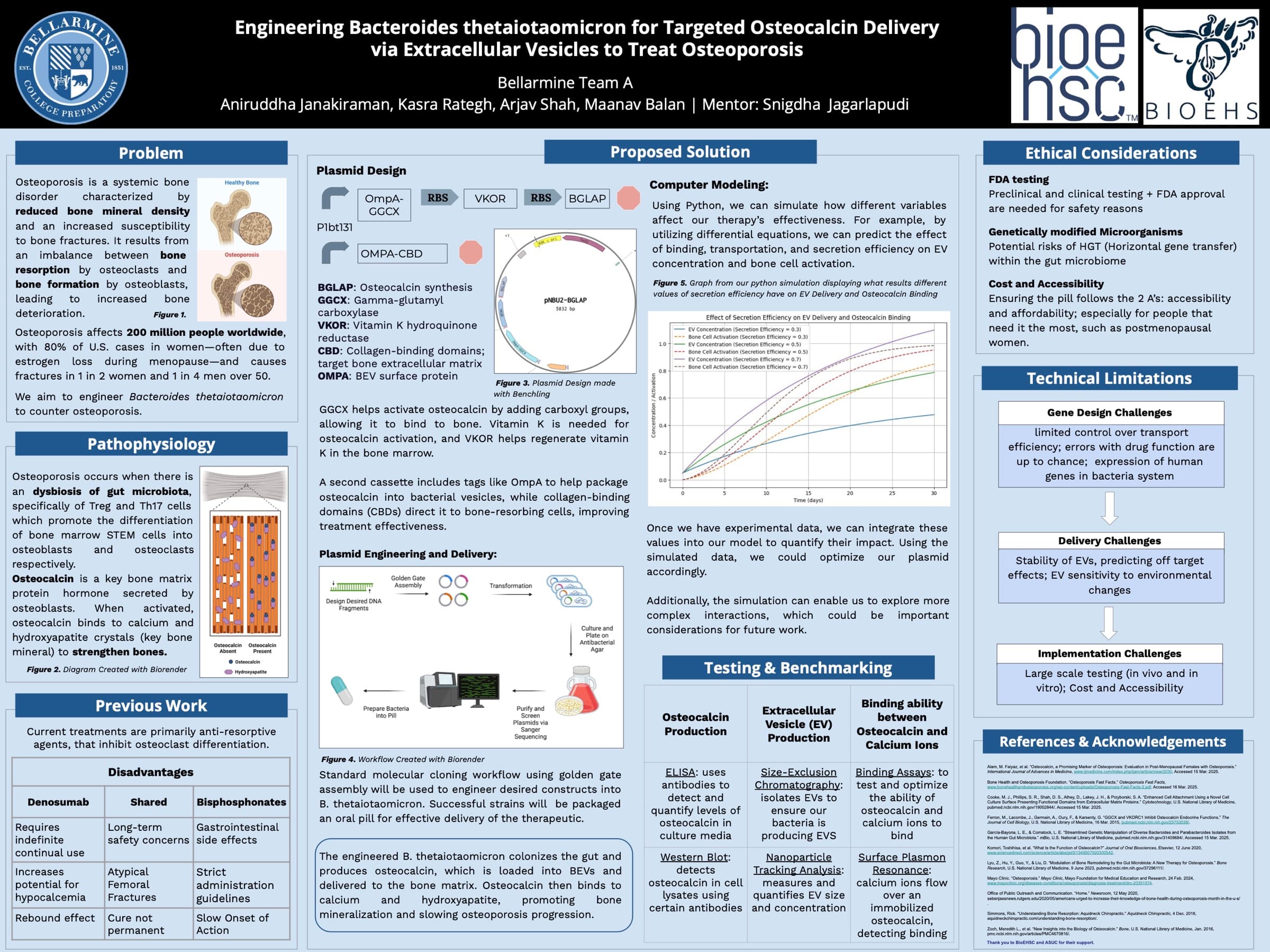
Osteoporosis reduces bone mineral density until fractures come easily. The cause is an imbalance between two cell types: osteoclasts, which break bone down, and osteoblasts, which build it back. When resorption outpaces formation, bone thins.
It affects roughly 200 million people worldwide. In the United States 80 % of cases are in women, largely because estrogen loss at menopause accelerates resorption, and it produces fractures in one in two women and one in four men over fifty.
The drugs in use are mostly anti-resorptive — denosumab, bisphosphonates — and they slow the breakdown rather than restore the building. Between them they carry indefinite dosing, a rebound effect on withdrawal, gastrointestinal side effects, atypical femoral fractures, and a slow onset, at $150–365 monthly.
Section
The proposal
The osteoclast–osteoblast balance is moderated by the gut: dysbiosis of the gut microbiota shifts the Treg/Th17 ratio and pushes bone-marrow stem cells toward resorption. So instead of dosing bone directly, the proposal edits a gut resident — Bacteroides thetaiotaomicron — and lets it manufacture what bone is missing.
That protein is osteocalcin, normally secreted by osteoblasts and, once carboxylated, able to bind calcium and hydroxyapatite in the bone matrix. A single plasmid, pNBU2-BGLAP (5,832 bp), carries everything that requires: BGLAP for the osteocalcin itself, GGCX and VKOR to carboxylate it and regenerate the vitamin K that carboxylation consumes, OmpA to load it onto bacterial extracellular vesicles, and collagen-binding domains so those vesicles accumulate at bone rather than circulating indefinitely.
The intended route is an oral capsule: Golden Gate assembly, transformation into B. theta, colony screening by Sanger sequencing, then the verified strain prepared as a pill.
Section
Simulating what we could not culture
A high-school team gets no anaerobic chamber, so the behaviour of the system was modelled instead: a set of differential equations in Python relating secretion efficiency, vesicle transport and binding rate to how much osteocalcin actually reaches bone.
The model does not demonstrate that the therapy works, and was never claimed to. Its use was to show which parameter dominates — secretion efficiency, not binding affinity — and therefore what a laboratory should measure first if anyone continued the work.
Section
How it would be tested
Each claim in the design was paired with the assay that would falsify it: ELISA and Western blot for whether the bacteria express osteocalcin at all, size-exclusion chromatography and nanoparticle tracking analysis for whether the vesicles form and at what size and concentration, and binding assays with surface plasmon resonance for whether the osteocalcin that arrives still binds calcium.
Section
What it is, and what it is not
This is a designed and defended proposal, not a result. Nothing was cultured, transformed or measured; the biology is drawn from published literature and the behaviour from simulation. The poster states its own limits plainly — human genes expressed in a bacterial host may fold or carboxylate incorrectly, vesicle stability and off-target accumulation are unknown, and horizontal gene transfer into a living microbiome is a genuine hazard that would have to be answered long before any of this approached a patient.
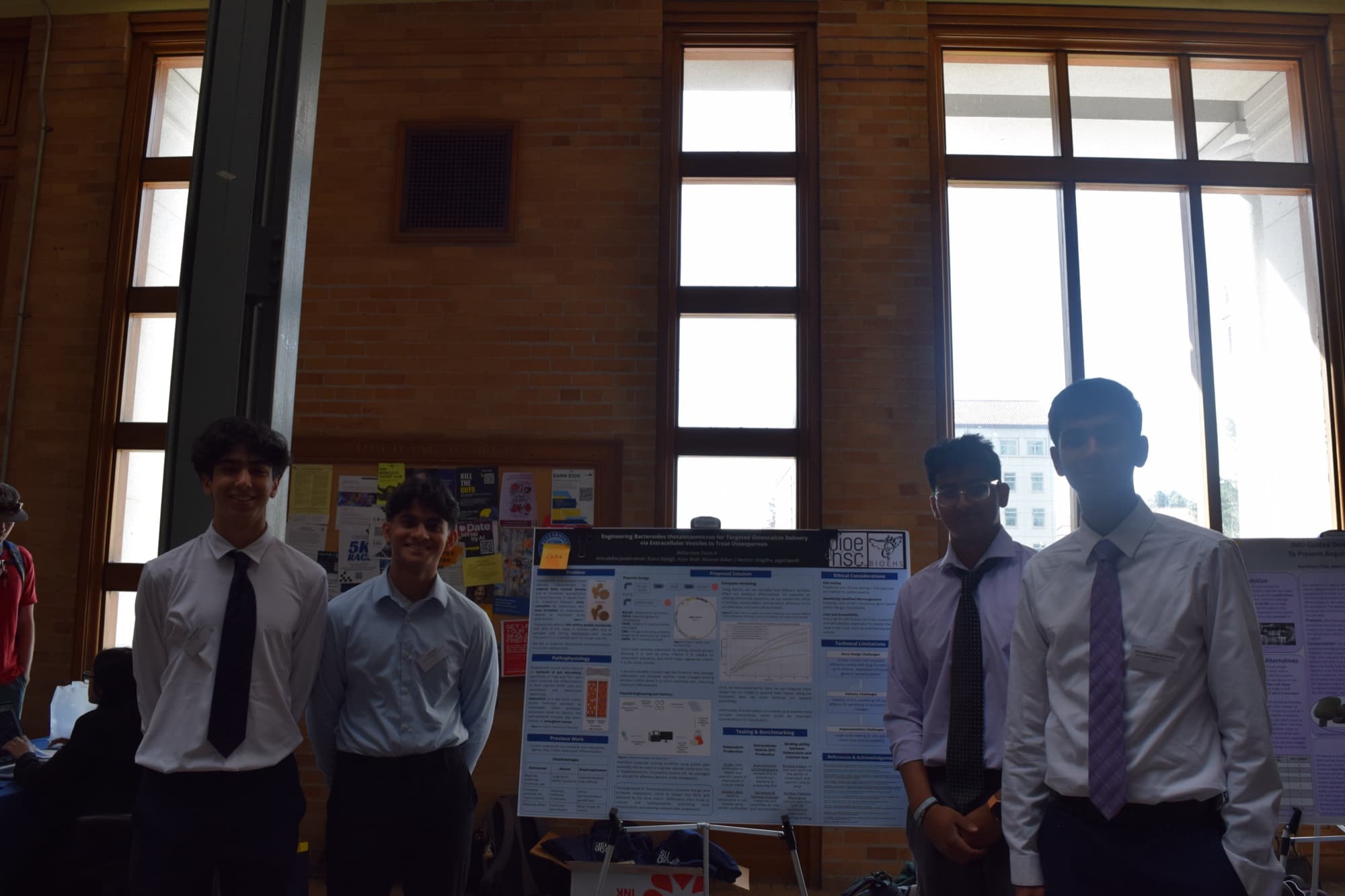
I led a team of four. A UC Berkeley student affiliated with the competition mentored us lightly; the research, the plasmid design, the simulation and the presentation were ours, split about evenly.
Links
Elsewhere
Next project