Project / 05
Air Trajectory
- Mechanical
- Hardware
- Calibration
A gravity-powered air launcher for Science Olympiad, calibrated over a hundred hours to land a ping-pong ball on targets 2 to 8 metres out.
Snapshot
The fast read
- Role
- Sole designer and builder
- Year
- 2024–25
- Status
- Competed
- Type
- Competition
- Team
- Built alone; a second pair of hands during calibration
- Stack
- Wood base, PVC chamber and barrel, Falling-mass piston
- Tags
- Mechanical · Hardware · Calibration
Section
The event
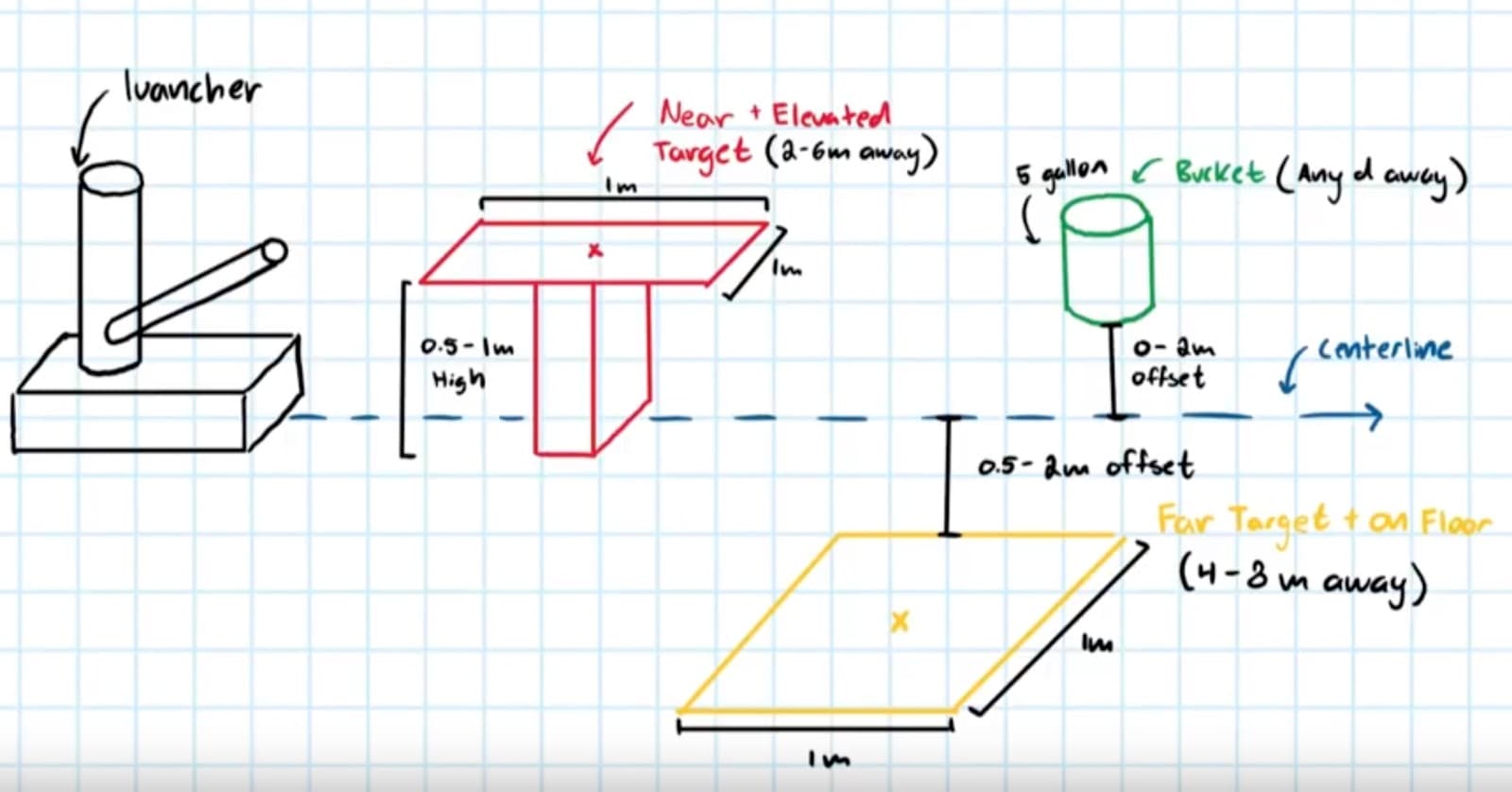
Air Trajectory is a Science Olympiad build event for a team of two. The device is impounded before the targets are announced, so it has to be calibrated in advance and then set from numbers alone.
One constraint defines the machine: all launch energy must come from a falling mass — 3.5 kg at most in Division C — converted into air pressure or air movement. No springs, no motors, no electrical parts, and every air chamber has to start and end at ambient pressure. In the 2024–25 season the device was released with a #2 pencil handed over by the event supervisor, and the competitor could touch nothing else.
Two targets: a near one between 2 and 6 metres and raised off the floor, and a far one between 4 and 8 metres lying flat, offset from the centre line by up to 2 metres. High score wins — 2000 minus the millimetres from the near target's centre, 4000 minus the millimetres from the far target's, best shot at each.
Section
The launcher
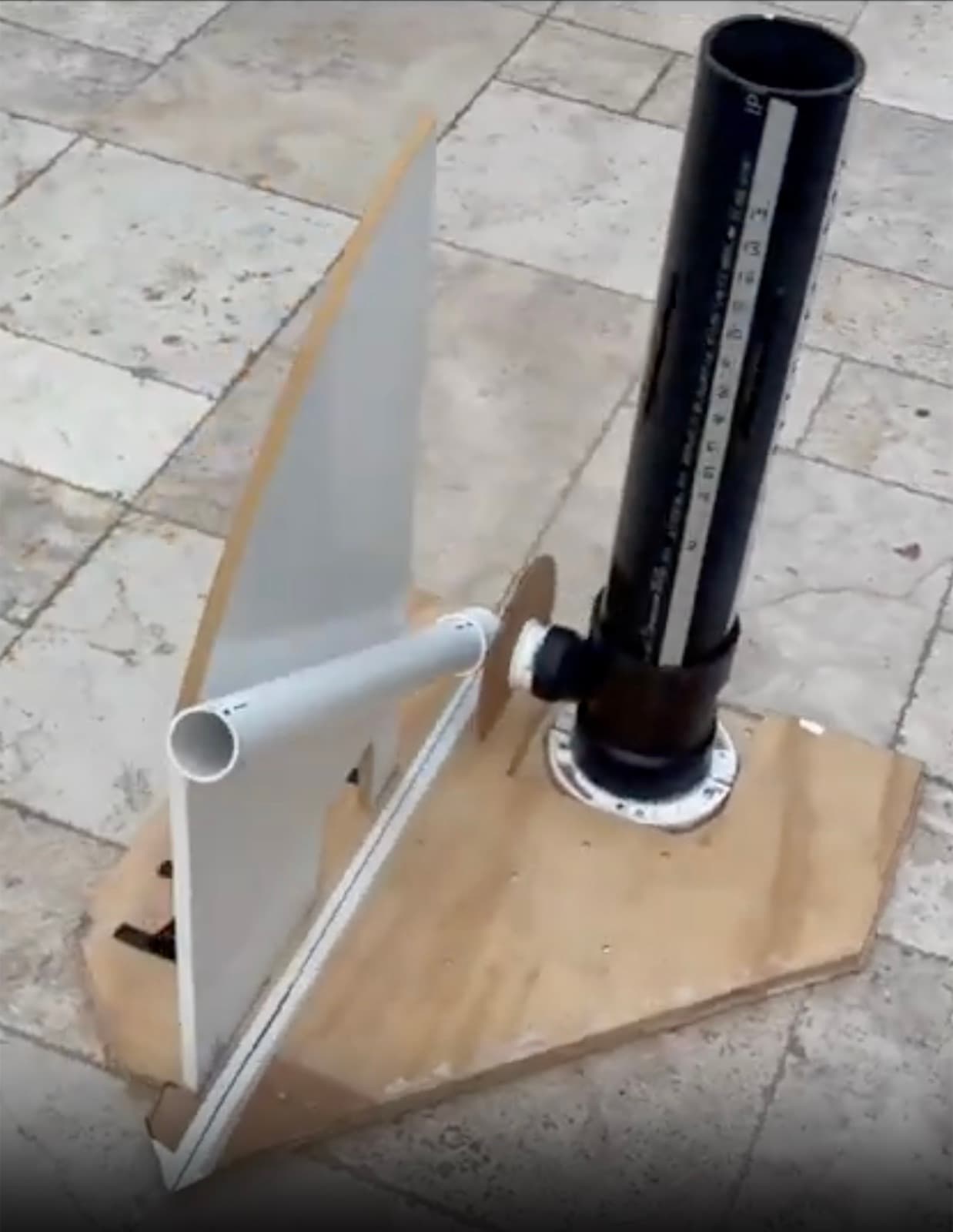
A mass falls down a piston and compresses air into a barrel, firing a ping-pong ball. Two settings aim it: the height the mass drops from, and the barrel's angle. Distance and target height both come out of that pair, which is why the calibration table matters more than the machine's peak performance.
The base is wood; the pressure chamber and barrel are PVC pipe.
Section
Engineering decisions
The first version could not reach the longest shot the rules allow, even at the full 3.5 kg. The cause was friction between the falling puck and the piston wall. Lubricant was the obvious fix and the wrong one: oil cannot be dosed identically shot after shot, so it buys distance at the cost of repeatability. Sanding the puck down was the choice instead — permanent, and the same on every launch.
Sanding left the puck slightly uneven, which introduced its own variable, so the puck was loaded in a fixed orientation every time.
The whole launcher slid on release. Rubber under the base and sandbags at set positions held it still.
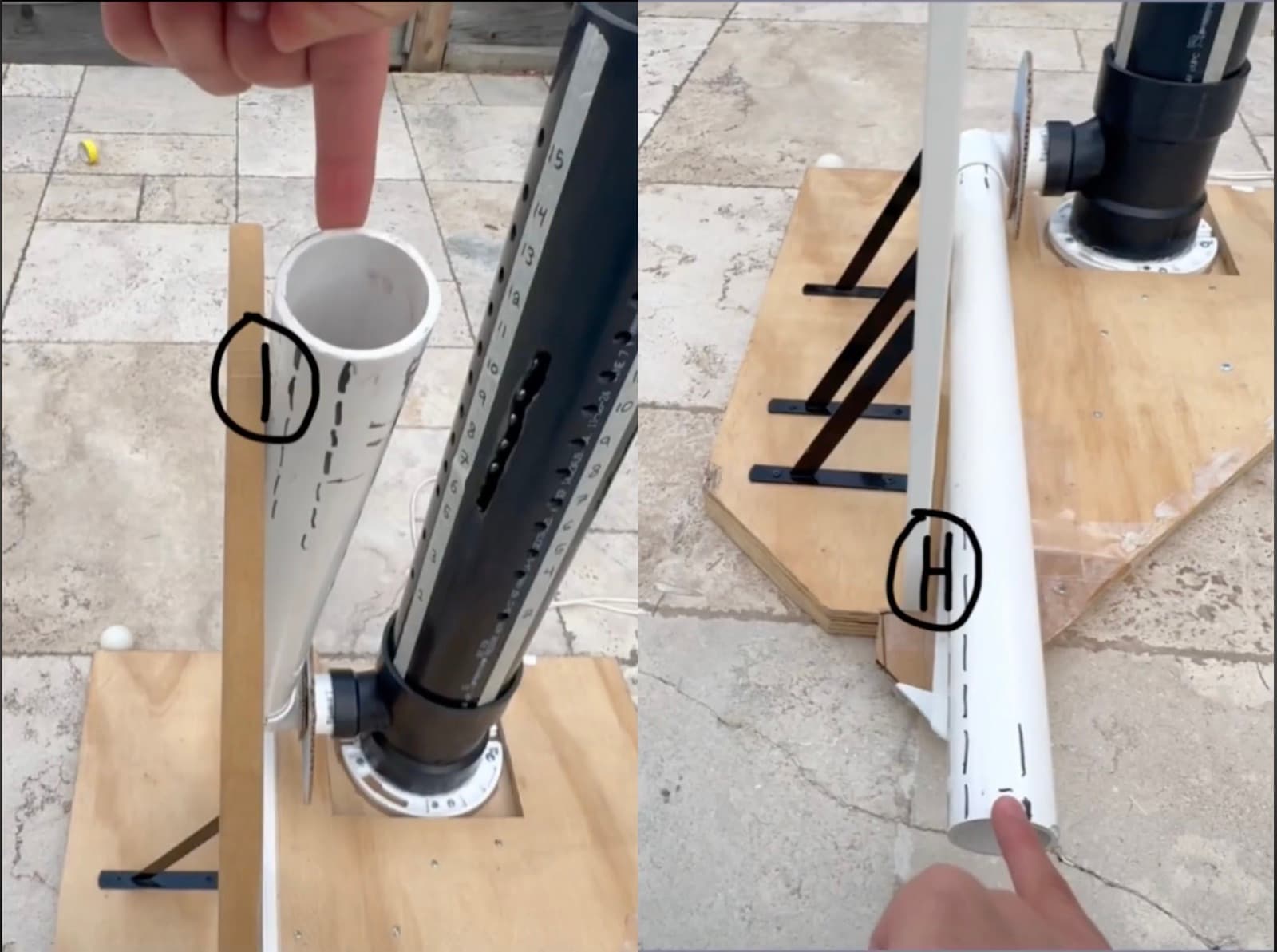
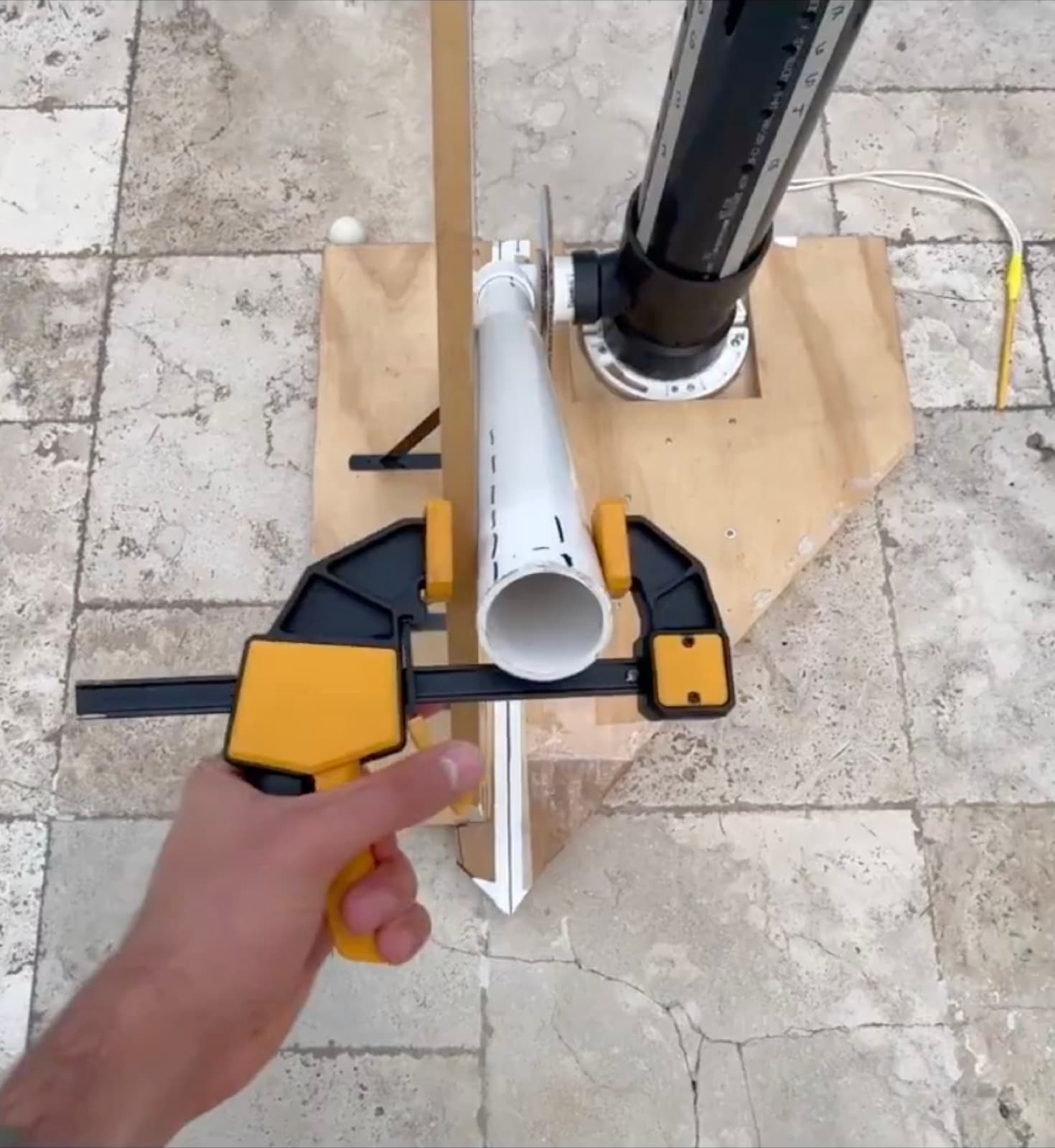
Horizontal accuracy was the hardest problem. Distance was consistent; left-and-right was not. As the barrel came down in angle, the connector unscrewed slightly and the barrel head ended up pointing somewhere marginally different. A wall clamped to the barrel head was built into the base to force the same position each time, but the wall was not rigid enough to remove the error entirely. The fix in the end was not mechanical: an angle marker placed behind the targets was used to characterise the horizontal offset for every drop-height and angle combination, and every value in the table was re-measured against it.
Section
Calibration
Over a hundred hours of testing in the school gym, working through combinations of drop height and launch angle and averaging several trials at each.
The point of that time was control rather than volume. Every run repeated the same sequence — the same loading order, the same setup steps, and angles always approached from above, so backlash in the adjustment landed the same way each time. Lasers and careful marking fixed the geometry.
Testing conditions matched the tournament as closely as possible, down to firing on a gym floor because the surface changes how a ball lands. Data recorded anywhere else was thrown out rather than mixed in.
Section
Evidence
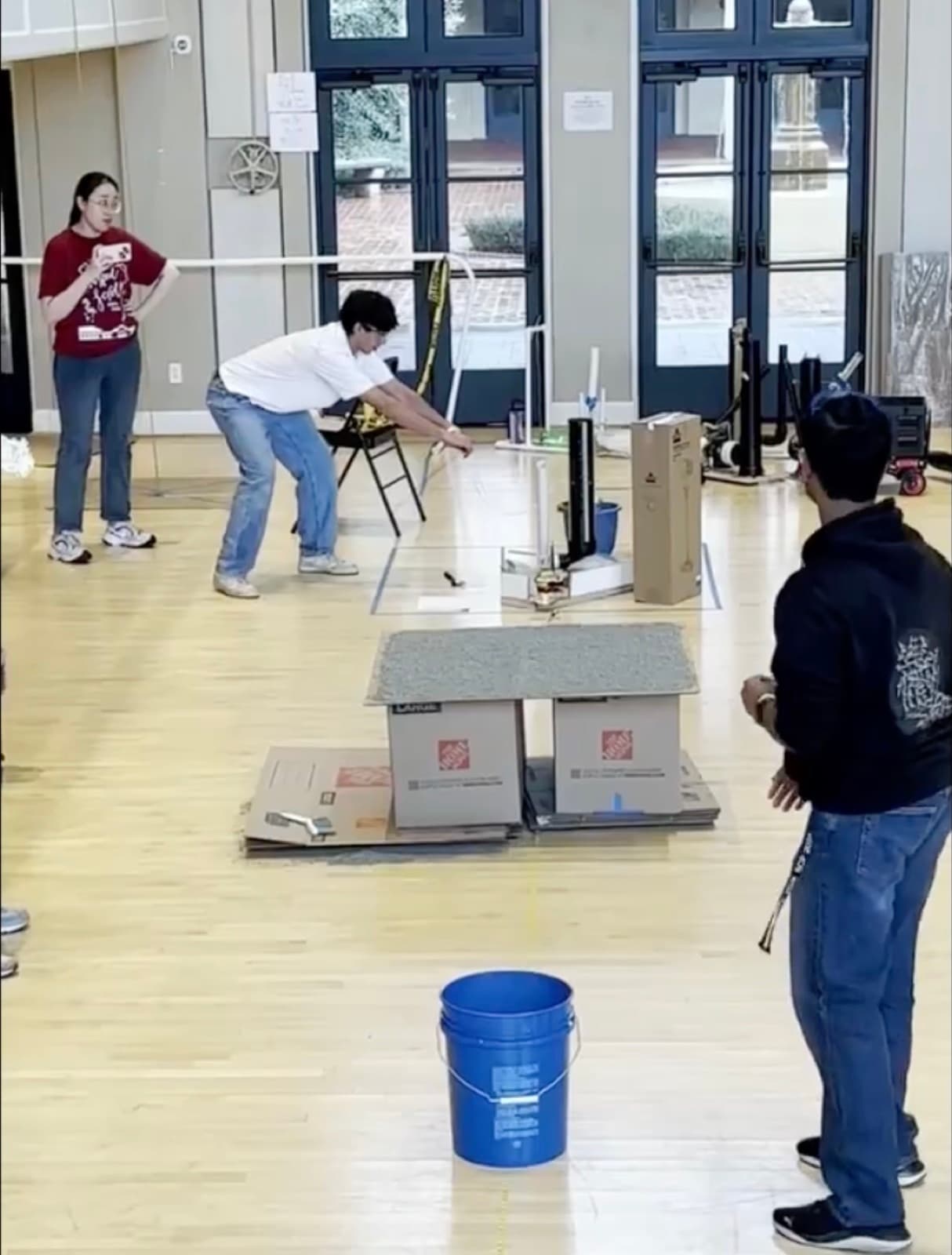
The film at the top of this page is the build in motion: setup, calibration and launches. The calibration tables and plots are still to come.
Section
Outcome
Third place at the Stanford Invitational and second at the Santa Clara Regional in the 2024–25 season.
At tournaments the launcher landed within 3 cm of the near target's centre and 4 cm of the far target's at its best, and hit the bucket — roughly a 12-inch opening — consistently at distances called on the day.
What is still unsolved is mostly material. Wood and PVC are not stiff enough, and the flex shows up as inconsistency. The horizontal error traced to the barrel connector would be better fixed by a rigid barrel lock than by the offset table that currently compensates for it. The machine is also big and heavy: tilting and positioning it accurately inside the competition time limit is harder than it should be, and a horizontal swivel would likely pay for itself.
Links
Elsewhere
Next project